Phase 1 study SOL-116
Peer-Reviewed Publication of First-in-Human Phase I Results for SOL-116
Subcutaneous SOL-116 showed a favourable safety and PK profile and confirmed target engagement, supporting the move into Phase IIa.
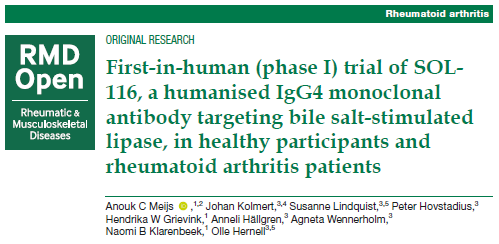
The results of its First-in-Human (FIH) Phase I trial of SOL-116 have been published in the peer-reviewed journal RMD Open. SOL-116 is Lipum’s first-in-class humanised IgG4 monoclonal antibody targeting bile salt-stimulated lipase (BSSL), a previously overlooked molecule implicated in chronic inflammation. The publication provides external, peer-reviewed validation of the data underpinning the continued clinical development of SOL-116.
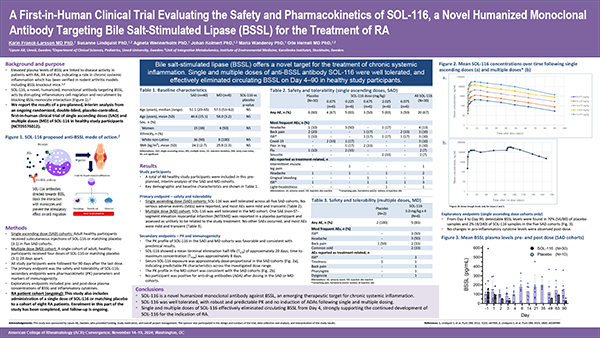
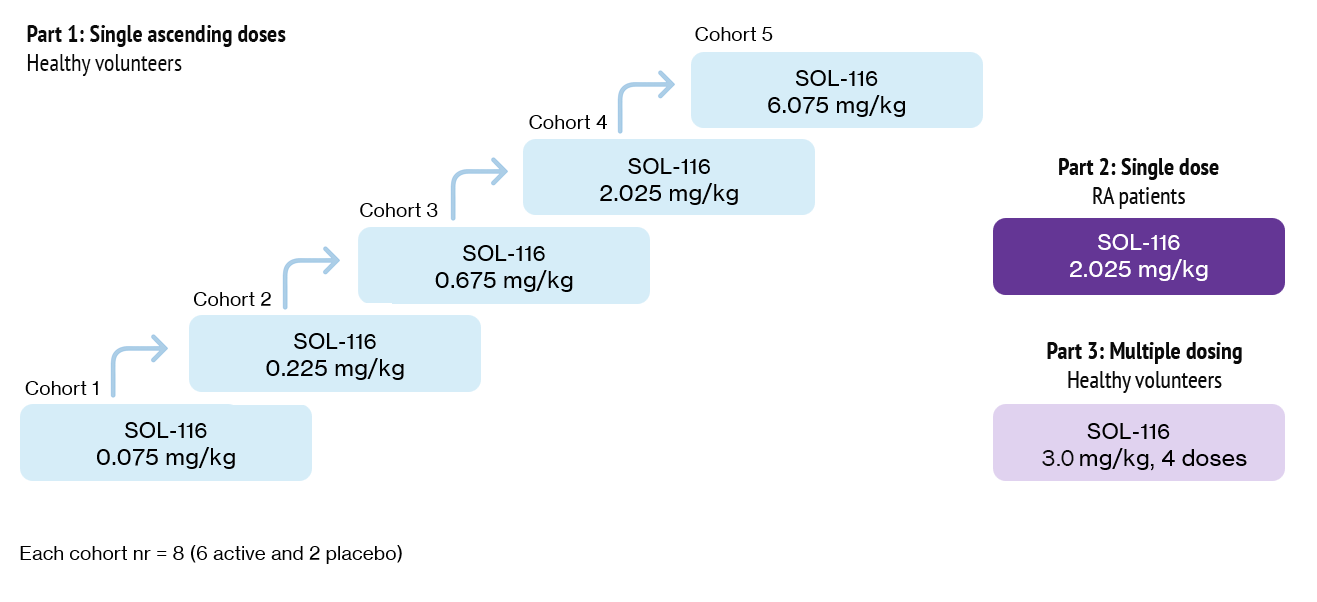
The randomised, double-blind, placebo-controlled trial (NCT05576012) evaluated subcutaneously administered SOL-116 in 56 participants: 48 healthy volunteers (40 across single ascending dose cohorts of 0.075–6.075 mg/kg, and 8 in a multiple-dose cohort of four doses of 3.0 mg/kg every four weeks) and 8 patients with mild RA receiving a single dose of 2.025 mg/kg or placebo. The primary objective was safety and tolerability, with pharmacokinetics (PK) and immunogenicity as secondary objectives and circulating free BSSL as an exploratory marker of target engagement.
Key findings:
- Safety and tolerability: Safe and well tolerated across all dose levels; the large majority of adverse events were mild, most commonly transient injection-site reactions. No serious adverse events were reported among SOL-116–treated participants.
- Pharmacokinetics: Dose-proportional exposure with a long terminal half-life (~16–20 days) supporting infrequent subcutaneous dosing, low accumulation on repeat dosing, and comparable PK in healthy volunteers and patients with RA.
- Immunogenicity: Anti-drug antibodies detected in only one of 336 post-dose samples.
- Target engagement: Free circulating BSSL was reduced to below the limit of quantification from day 4, sustained for up to 12 weeks and already at the lowest dose — confirming engagement of the intended target.
Based on these data, Lipum is advancing a fully funded Phase IIa proof-of-concept study in patients with RA, now in start-up, designed to evaluate clinical efficacy, safety and pharmacokinetics and to further explore BSSL- and disease-related biomarkers.
“These are strong first-in-human results. SOL-116 showed a favourable safety and tolerability profile, predictable pharmacokinetics that support convenient subcutaneous dosing, and low immunogenicity. Importantly, we saw a clear and sustained reduction of free circulating BSSL — already at the lowest dose — confirming that SOL-116 reaches and blocks its target as intended. This is exactly the foundation we wanted before testing efficacy in patients, and we now look forward to our Phase IIa proof-of-concept study, which is fully funded and in start-up,” says Peter Hovstadius, MD, PhD, Chief Medical Officer at Lipum.